Why Morning Messages Strengthen Bonds Between Couples

Why Morning Messages Strengthen Bonds Between Couples
Morning messages are intentional daily signals that confirm presence, appreciation, and emotional safety, and they are one of the most reliable ways couples strengthen their bond over time. The science behind why morning messages strengthen bonds is grounded in neuroscience: a simple “good morning” triggers the release of dopamine, serotonin, and oxytocin, while simultaneously lowering cortisol, the body’s primary stress hormone. These biochemical shifts do not require a long message or a poetic declaration. Consistency is the active ingredient. Couples who send brief, regular morning greetings report stronger feelings of security and connection than those who rely on occasional deep conversations. The habit works because the brain reads repetition as evidence of safety, and safety is the foundation of lasting intimacy.
Why morning messages strengthen bonds: the neuroscience
Morning messages work on the brain before the conscious mind fully processes them. When a partner receives a warm greeting early in the day, dopamine, serotonin, and oxytocin are released in sequence. Dopamine creates motivation and pleasure. Serotonin produces calm. Oxytocin deepens the sense of bonding and trust.
Cortisol naturally peaks in the first hour after waking. This is called the cortisol awakening response, and it primes the body for the demands of the day. A positive morning message interrupts that stress spike and replaces it with a signal of connection. The nervous system reads the message as evidence that the relationship is stable, which lowers defensive behaviors like withdrawal or irritability.
Researchers describe this mechanism as a “proof-of-work protocol”. Each message is a small deposit into the attachment system. Over time, those deposits build a biological baseline of trust. The partner’s nervous system stops asking “Am I safe in this relationship?” and starts operating from the assumption that the answer is yes.
“Consistent messages shift a partner’s baseline from ‘Am I safe?’ to ‘I know I am safe.’ That shift changes everything about how two people interact throughout the day.”
Positive emotional priming via morning messages also carries forward into later interactions. A partner who starts the day feeling valued is measurably warmer in subsequent conversations, more resilient to stress, and less likely to interpret neutral events as threats.
Pro Tip: Send your morning message before your partner typically checks their phone. That way, it is the first thing they see when they wake up, maximizing the cortisol-lowering effect.
Does consistency matter more than what you actually say?
The short answer is yes. Consistency predicts relationship satisfaction more reliably than message depth or length. A simple “good morning, thinking of you” sent every day outperforms a beautifully written paragraph sent once a week.
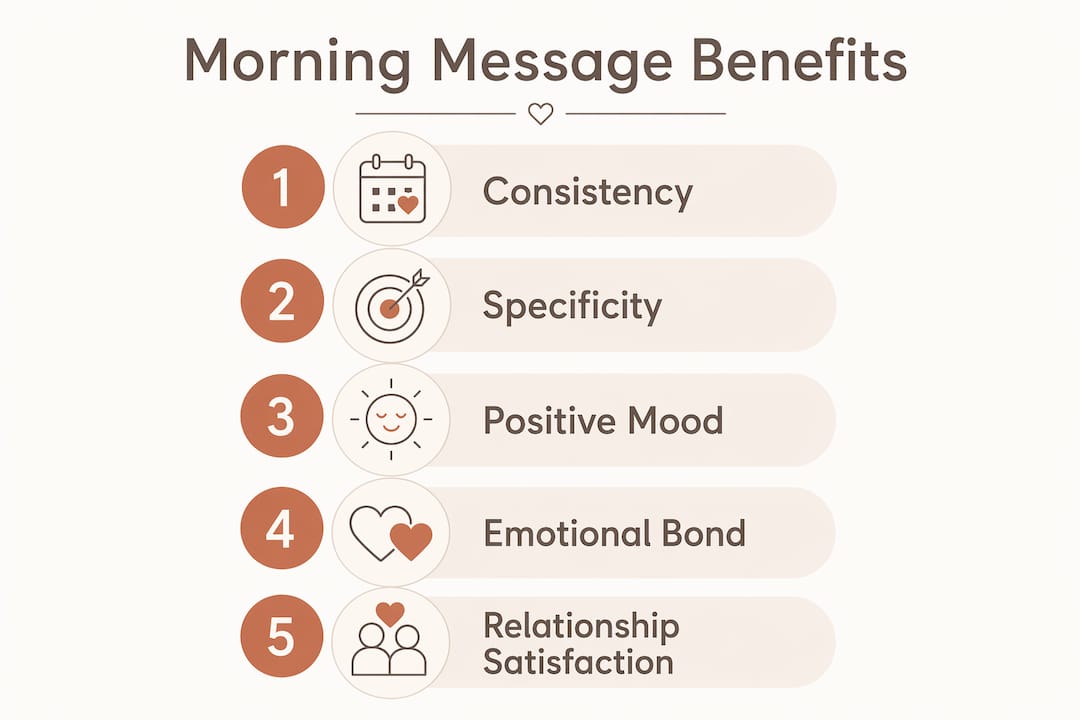
The reason is psychological rhythm. Recurring morning greetings create a predictable pattern that the brain associates with safety and belonging. This is similar to how background social contact works in close communities. People do not need deep conversations every day to feel connected. They need regular, low-effort signals that confirm the relationship is still present and active.
Here is what consistent morning messages accomplish that sporadic deep messages cannot:
- They replicate the feeling of shared daily life, even when couples are physically apart.
- They lower isolation by disrupting negative mental loops and pivoting partners into connection mode.
- They create an emotional anchor that stabilizes mood before the day’s demands take over.
- They signal reliability, which the attachment system reads as evidence of commitment.
- They build a cumulative record of care that partners draw on during conflict or stress.
The cognitive psychology concept at work here is positive emotional priming. Each morning message primes the recipient to interpret later interactions through a warmer, more generous lens. That priming effect compounds over weeks and months, gradually shifting the emotional tone of the entire relationship.
Pro Tip: Set a recurring phone reminder at 7:00 AM labeled “Send morning message.” Treat it like a non-negotiable appointment. The habit forms faster when it is scheduled rather than intention-based.
How to make morning messages feel personal
Generic greetings maintain connection, but personalized messages deepen it. Specific observations or gratitude double a partner’s feeling of being uniquely valued compared to a standard “good morning.” The difference between the two is the difference between feeling acknowledged and feeling truly seen.

Generic vs. personalized: what the contrast looks like
| Generic message | Personalized message |
|---|---|
| “Good morning! Hope you have a great day.” | “Good morning. I keep thinking about how you handled that situation yesterday. You were so patient.” |
| “Morning! Miss you.” | “Morning. I woke up thinking about our trip last spring. Can’t wait to do that again with you.” |
| “Have a good one!” | “Have a good one. Thank you for making dinner last night when I was exhausted. It meant a lot.” |
The personalized versions reference a specific action, memory, or quality. That specificity tells the partner: “I notice you. I remember you. You matter to me in particular, not just in general.”
Expressions of specific appreciation that include “why it mattered” create the strongest emotional responses. A message like “Thank you for handling bedtime last night, because I was exhausted and it made me feel supported” lands far deeper than “Thanks for your help.”
Couples should also avoid using morning messages for logistics or problem-solving. Mornings are a high-cortisol time, and opening the day with a task list or unresolved conflict activates stress rather than connection. Keep the morning message emotionally light and affirmative. Save the scheduling and the difficult conversations for later in the day.
Here are the elements that make a morning message genuinely personal:
- A reference to something specific the partner said, did, or felt recently.
- An expression of gratitude that names the action and its emotional impact.
- A shared memory or inside reference that only the two of you would recognize.
- A simple observation about what you love or admire about them right now.
Common mistakes couples make with morning messages
The most common mistake is confusing intensity with impact. Couples sometimes skip days because they feel they have nothing meaningful to say. Emotional benefits come from rhythm and reliability, not from the depth of any single message. A short, warm message sent consistently does more for the relationship than an occasional long one.
Other frequent missteps include:
- Using morning messages for logistics. Asking about bills, schedules, or unresolved arguments first thing in the morning raises cortisol and trains the partner to dread seeing your name on their screen.
- Letting the routine lapse without acknowledgment. Missing a day is fine. Missing a week without explanation creates emotional uncertainty. If the habit breaks, restart it with a brief note that reconnects rather than explains.
- Ignoring your partner’s preferences. Some partners prefer a short, playful message. Others respond better to something warm and sincere. Sending the message you would want to receive, rather than the one they actually need, reduces its impact.
- Treating the message as a checkbox. A copy-pasted “gm” sent out of obligation carries no emotional signal. The message does not need to be long, but it does need to feel like it came from a person who is thinking about their partner specifically.
- Expecting immediate reciprocation. Morning messages build connection over time. Measuring their value by whether the partner responds immediately misses the point entirely.
When the routine lapses, recovery is straightforward. Send a message that references the gap warmly and without drama. Something like “I’ve been off my game this week, but I woke up thinking about you” restores the rhythm without turning the lapse into a conflict.
Key Takeaways
Morning messages strengthen bonds because consistent, specific, and emotionally light greetings build biological trust, lower defensive behaviors, and create a shared emotional baseline that carries through the entire day.
| Point | Details |
|---|---|
| Consistency over content | A short daily message builds more security than an occasional long one. |
| Neurological impact | Morning messages trigger dopamine, serotonin, and oxytocin while reducing cortisol. |
| Personalization doubles impact | Specific gratitude and shared references make partners feel uniquely valued. |
| Avoid morning logistics | Keep messages emotionally light; problem-solving early raises stress for both partners. |
| Recovery is simple | If the habit breaks, restart warmly and without drama to restore the rhythm. |
What I’ve learned from watching small messages build big trust
I have watched couples who communicate beautifully in therapy sessions struggle to maintain connection between appointments. The ones who close that gap fastest are almost never the ones who send the most eloquent messages. They are the ones who show up every morning, even with something small.
There is a concept in attachment research that I find genuinely useful here: the idea that the attachment system runs on evidence, not declarations. Your partner’s nervous system does not update its sense of safety based on how much you love them in theory. It updates based on what you actually do, repeatedly, over time. A morning message is one of the smallest possible deposits into that system. But small deposits made daily compound into something the relationship can actually stand on.
The couples I have seen benefit most from this habit are not the ones who write beautifully. They are the ones who are reliably there. That reliability, more than any single message, is what tells a partner: “You are not alone in this.”
My honest advice is to lower your expectations for what a morning message needs to be. It does not need to be moving. It does not need to be creative. It needs to be consistent, warm, and specific enough to show that you were thinking about your partner as a real person, not just fulfilling an obligation. That is enough. Over time, it is more than enough.
— Alan
How Pingher helps couples stay consistently connected
Maintaining a daily morning message habit is simple in theory and surprisingly easy to let slip in practice. Life gets busy, and the intention to reach out gets crowded out by everything else.
Pingher is built specifically for this challenge. The platform gives couples a way to send personalized, thoughtful messages with minimal effort, so the habit stays alive even on the busiest mornings. Its one-tap functionality means expressing care does not require composing something from scratch every day. Couples who want to build the kind of consistent, emotionally meaningful communication this article describes will find that Pingher removes the friction that usually breaks the habit. The message still comes from you. The platform just makes sure it actually gets sent.
FAQ
Why do morning messages strengthen emotional bonds?
Morning messages trigger the release of dopamine, oxytocin, and serotonin while lowering cortisol, creating a positive emotional baseline that reinforces trust and connection. The nervous system reads repeated morning greetings as evidence of safety, which deepens attachment over time.
How long does a morning message need to be?
Length does not determine impact. Consistency and specificity matter far more than word count. A short, warm message sent every day builds stronger bonds than a long message sent occasionally.
What should I avoid saying in a morning message?
Avoid logistics, unresolved conflicts, and problem-solving in morning messages. Mornings are a high-cortisol period, and heavy topics early in the day activate stress rather than connection.
How quickly do morning messages improve a relationship?
The benefits of morning texts accumulate gradually through repeated deposits into the attachment system. Most couples notice a shift in emotional tone within a few weeks of consistent daily messaging.
What makes a morning message feel personal?
A personalized morning message references a specific action, shared memory, or quality the partner recently showed. Adding “why it mattered” to any expression of gratitude significantly increases its emotional impact.
Recommended
Built for couples who care.
Pingher helps you send the right words at the right moment.
Get Pingher on Google Play