Why Love Needs Regular Expression to Actually Last
Why Love Needs Regular Expression to Actually Last
Love needs regular expression because connection fades quietly when it’s left unspoken, not dramatically when it’s contested. Small, repeated acts of affection, said or shown daily, keep partners feeling chosen. Three to try right now:
- Send a 15-second morning text before you even get out of bed. ☀️
- Give a six-second hug or kiss at your next hello or goodbye. 🤗
- Say one specific thing you appreciated about your partner tonight, in 30 seconds or less. 🌙
None of these take more than half a minute, and that’s the point.
Key Takeaways
Regular, small expressions of love, not occasional grand gestures, are what sustain perceived belonging and long-term relationship satisfaction.
| Point | Details |
|---|---|
| Small deposits beat big gestures | Daily rituals function like deposits into an Emotional Bank Account, according to Gottman research. |
| Feeling loved predicts satisfaction | How loved your partner feels matters more than how loving you believe you are being. |
| Use existing transitions | Attach rituals to mornings, goodbyes, reunions, and bedtime so they need no extra planning. |
| Shared meaning is required | A gesture only works as a ritual when both partners agree it’s meaningful, not just routine. |
| Automate the habit | Pingher schedules short, personalized messages so busy couples keep the ritual going without relying on memory. |
Table of Contents
- Why Frequent Small Gestures Change How Partners Feel
- Simple Daily Rituals Busy Couples Can Start Tonight
- How to Make These Rituals Stick When Life Gets Busy
- Ready-to-Send Messages for Busy Partners
- Why Pingher Focuses on Tiny, Repeatable Acts
- Send the Message Before You Forget
- Sources
- FAQ
Why Frequent Small Gestures Change How Partners Feel
Relationship researchers at The Gottman Institute describe small rituals, morning check-ins, reunion kisses, nightly appreciation, as deposits into what they call an Emotional Bank Account. Every tiny gesture adds a little trust. Skip too many, and the account runs low long before either partner notices a fight brewing.
Here’s the part most people miss: how loved your partner feels predicts relationship satisfaction more reliably than how loving you believe you’re being. A large-scale analysis of perceived partner behavior found that subjective experience of being loved outweighs self-rated effort. You can feel like a devoted partner and still leave your partner feeling unseen if the small, visible signals aren’t landing.
There’s a physiological layer too. Affectionate touch and warm attention are tied to affection’s link with compassion and higher relationship satisfaction, and brief physical contact triggers oxytocin, the hormone tied to bonding and stress reduction. Baumeister and Leary’s belongingness research backs this up from a different angle: humans have a basic need to feel securely attached to at least one other person, and that need doesn’t get satisfied by a single grand gesture. It gets satisfied by repetition.
The practical takeaway isn’t “try harder to be loving.” It’s “make sure your partner feels loved, today, in a way they’d actually recognize.”
Simple Daily Rituals Busy Couples Can Start Tonight
You don’t need a date night calendar or a therapy workbook to close the gap. You need a handful of rituals attached to moments that already happen every day.
- Morning check-in (15 to 30 seconds): A text, a squeeze of the hand, or “thinking of you” before the day splits you apart.
- Goodbye ritual (10 to 20 seconds): A specific goodbye phrase or gesture, not just “bye, love you” on autopilot.
- Reunion greeting (6+ seconds): Psychology Today’s research on daily connection points to a six-second kiss or hug as long enough to release oxytocin and register as genuine contact, not a peck in passing.
- Bedtime appreciation (30 to 60 seconds): Name one specific thing your partner did that day. Specificity beats “you’re great.”
- Weekly micro-date (15 to 20 minutes): Coffee on the porch, a walk around the block, phones away.
If you’re traveling or apart for work, the same rituals translate directly: a scheduled morning text, a voice note instead of a hug, a quick call at the time you’d normally reunite. The mechanism doesn’t require proximity. It requires consistency.
Pro Tip: A ritual only works if both of you agree it means something. Research on rituals of connection found the same action can be a meaningful ritual for one partner and empty routine for the other. Ask, don’t assume.
How to Make These Rituals Stick When Life Gets Busy
Habits form faster when they’re attached to something you already do, not floating on their own.
- Pair the ritual with an existing cue. Send the morning text while your coffee brews. Say the appreciation line while brushing your teeth before bed.
- Keep it under 60 seconds at first. Ambition kills consistency. Small and repeatable beats elaborate and abandoned.
- Set a one-week micro-goal. Aim for five out of seven days, not a perfect streak.
- If a ritual feels forced, say so gently. “I love that you text every morning, but I feel more connected when you call instead” is a fix, not a complaint.
- Watch for mismatched love languages. One partner’s meaningful gesture is another’s background noise; matching how you express love to what your partner actually wants tracks with higher satisfaction for both people.
Pro Tip: If a ritual starts feeling like a chore, don’t scrap it. Scale it down or swap the modality. A stressed “good morning” text still counts more than silence.
Ready-to-Send Messages for Busy Partners
Copy these, tweak the details, and send. Personalizing even one word (a nickname, an inside joke) makes a template feel handwritten.
Morning:
- “Woke up thinking about you. Have a good one. ☀️”
- “Coffee’s brewing and so am I, missing you already.”
Midday check-in:
- “No reason, just wanted you to know I’m thinking of you.”
- “Hope your afternoon is going easier than it looks.”
Reunion:
- “So glad you’re home.”
- A voice note: “Tell me one good thing from your day.”
Bedtime:
- “Today I appreciated how you [specific thing]. Goodnight.”
- “Grateful for you. Sleep well.”
Try a seven-day micro-challenge: pick three templates, send one each morning and one each night, and notice how your partner responds by day four or five. If they reply coldly at first, don’t scrap the habit, some people need a few repetitions before the pattern registers as real. For more ideas on daily notes that land, see this rationale for why daily love notes matter.
Why Pingher Focuses on Tiny, Repeatable Acts
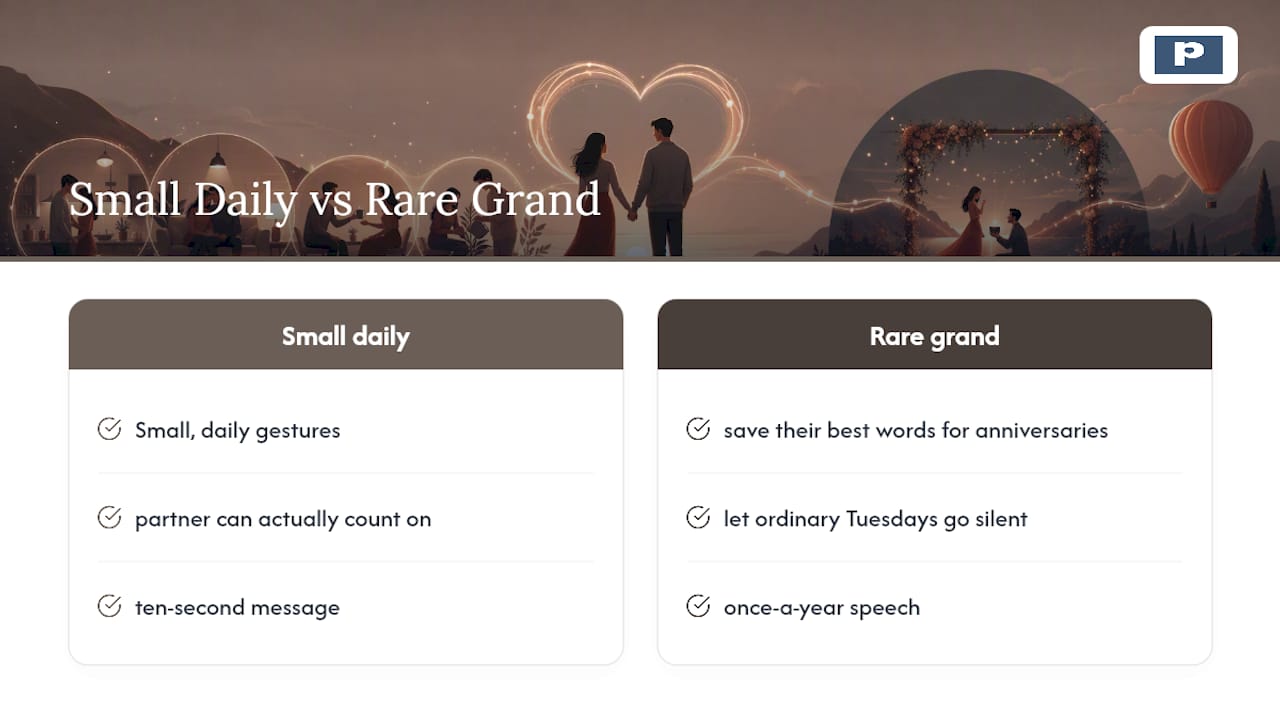
I’ve watched too many couples save their best words for anniversaries and let ordinary Tuesdays go silent. Small, daily gestures beat rare grand ones because they’re the ones your partner can actually count on. That belief shaped Pingher from day one: build a tool for the ten-second message, not the once-a-year speech.
Send the Message Before You Forget
Busy schedules are the number one reason regular expression falls apart, not lack of love. You mean to text back, mean to say the nice thing out loud, and the day swallows it whole. Pingher is built for exactly that gap: it schedules short, personalized messages so the daily ritual happens even on your worst week.
Getting started takes three steps. Download the app, pick three templates that match your rituals (a morning line, a reunion greeting, a bedtime appreciation), and schedule them for the week ahead with one tap each. There’s a free tier to test the habit before committing to anything, and the app is built to stay private and ad-free, no data mining your relationship for ad targeting. If you’ve been meaning to text her something real for weeks, open Pingher and send the first one tonight.
Sources
- The little things that keep love strong — The Gottman Institute
- Feeling loved versus being loving: perceived partner behavior predicts relationship satisfaction - PMC
- Busy but connected: Strengthening your relationship daily — Psychology Today
- Rituals of connection and shared symbolic meaning (HBS working paper)
FAQ
Why does love need regular expression instead of occasional big gestures? Big gestures are memorable but rare, leaving long gaps where a partner can feel neglected. Regular, small expressions keep the sense of being loved current, which research ties more closely to relationship satisfaction than infrequent grand acts.
How long should a daily ritual actually take? Most effective rituals run between 6 seconds (a real hug) and 60 seconds (a specific appreciation at bedtime). The goal is consistency, not duration.
What if my partner doesn’t respond the way I hoped? Give it a few repetitions before judging the ritual. If it still falls flat, ask directly what makes them feel loved rather than assuming your effort translates automatically.
Can technology actually help with something this personal? Yes, when it removes the friction of remembering, not the sentiment. Scheduling a message in advance with an app like Pingher still means your own words reach your partner at the moment you chose.
Recommended
Built for couples who care.
Pingher helps you send the right words at the right moment.
Get Pingher on Google Play