What Are Affection Reminders and Why They Matter

What Are Affection Reminders and Why They Matter
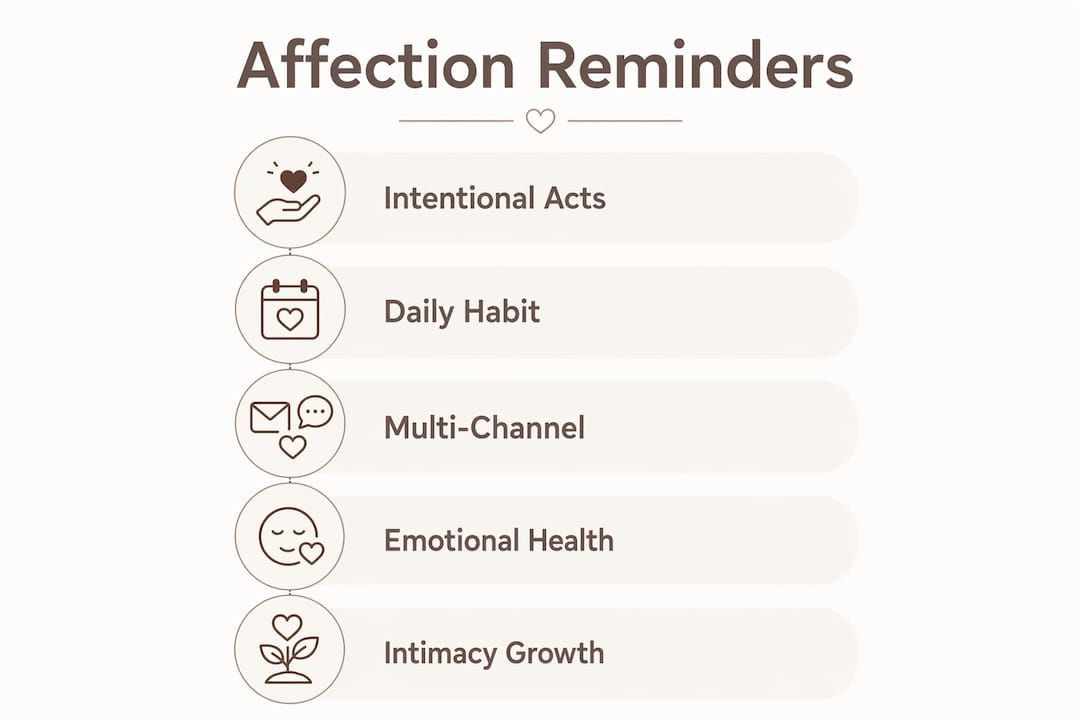
Affection reminders are defined as intentional, small daily actions, such as a brief text, a sticky note, or a quick hug, that help your partner feel consistently valued and emotionally connected. They are not grand romantic gestures. They are the quiet, repeated signals that say “I see you, and I choose you.” Relationship psychology research supports this approach: Dr. John Gottman’s work shows that healthy couples maintain roughly a 5:1 ratio of positive to negative interactions. That ratio is built through small, frequent acts, not occasional big ones. Affection reminders are the practical tool for hitting that number every day.
What are affection reminders and how do they work?
Affection reminders are deliberate, low-effort expressions of love that you send or show your partner on a regular basis. The key word is deliberate. Without intention, daily life creates what psychologists call “normalization,” the slow fade where familiarity breeds emotional invisibility. Your partner stops feeling noticed. Affection reminders interrupt that fade by forcing genuine moments of attention.
They work across three main channels, each with a different emotional texture:
- Verbal reminders: Written or spoken affirmations, supportive texts, gratitude notes, or a specific compliment tied to something your partner actually did. “I noticed how patient you were with your mom today” lands harder than “I love you” said on autopilot.
- Direct nonverbal reminders: Brief, consensual physical touch. A five-second hug before leaving for work, holding hands during a walk, or a hand on the shoulder while your partner reads. These gestures activate the body’s stress-response system in reverse, lowering cortisol and building a sense of safety.
- Indirect nonverbal reminders: Acts of service and small gifts. Filling their water bottle before they ask, leaving a snack on their desk, or picking up their favorite coffee on a Tuesday for no reason. These say “I was thinking about you” without a single word.
The most effective approach uses all three channels. Tailoring these behaviors to your partner’s preferences multiplies their impact. A partner who values acts of service will feel more loved by a clean kitchen than by a poem.
Pro Tip: Start with one channel your partner responds to most visibly, then layer in a second channel after two weeks. Building the habit one channel at a time prevents it from feeling like a chore.

Why are affection reminders important for long-term relationship health?
Consistent small gestures build something that grand romantic acts cannot: trust over time. A surprise vacation is memorable. A daily text that says “thinking of you” is what makes a partner feel secure on an ordinary Wednesday. Daily small acts fuel long-term relationship satisfaction more reliably than rare, large gestures.
The psychological mechanism behind this is Gottman’s positive interaction ratio. Healthy relationships sustain approximately five positive interactions for every one negative exchange. That ratio is not maintained through anniversary dinners. It is maintained through micro-moments: a smile across the room, a word of encouragement before a hard meeting, a text that asks “how did it go?”
“Love is a daily practiced choice, and affection reminders function as ongoing invitations for attention and connection. Couples with a practice of small, specific acts feel deeper connection than those relying on romance alone.” — Athenian Counseling, couples therapy perspective
Affection reminders also protect against emotional invisibility. Familiarity is the quiet enemy of intimacy. When partners stop actively signaling affection, each person gradually feels less seen. That feeling does not announce itself loudly. It accumulates. Affection reminders break the cycle by signaling that your partner is seen, valued, and chosen, not just assumed.
Consistent expressions of gratitude rank among the most effective verbal affection reminders. Gratitude is specific by nature. It names what the other person did and why it mattered. That specificity is what makes it land. Clinical counselors describe affection as a practiced skill, not a passive feeling. You get better at it by doing it, not by waiting to feel inspired.
How can you personalize affection reminders to your partner’s needs?
The most common mistake couples make is expressing affection in the way they personally prefer to receive it. A partner who loves words of affirmation will write long, heartfelt notes. Their partner, who values quality time, receives those notes warmly but does not feel the same emotional charge. The note misses the mark, not because of lack of love, but because of a mismatch in love language.
Personalization requires a calibration phase. Here is a practical way to run it:
- Observe responses over two weeks. Notice which gestures make your partner visibly light up. A smile, a longer hug back, a comment later in the day. These are data points.
- Test one new channel per week. Try a handwritten note one week, a specific verbal compliment the next, then an act of service. Track which one generates the warmest response.
- Ask directly, but frame it as curiosity. “What made you feel most appreciated this week?” is a question that invites honest feedback without pressure.
- Adjust based on what you learn. If your partner mentions the coffee you picked up more than the note you left, that tells you something. Acts of service are speaking louder for them right now.
Tracking responses to different gestures leads to better intimacy and emotional satisfaction over time. This is not a one-time exercise. Partners change. Stress, life stages, and circumstances shift what feels most meaningful. Revisit your calibration every few months.
Pro Tip: Specificity beats frequency. Saying “I love how you remembered my sister’s birthday without being reminded” is more powerful than ten generic “I love yous.” Specific affirmations prove you are paying attention.
What practical affection reminders can you use every day?
Daily affection reminders do not require extra time. They require intention. The goal is to anchor small rituals to moments that already exist in your day.
Here are affection reminder ideas organized by format and timing:
- Morning: A five-second hug before either of you checks your phone. A specific “good luck today” tied to something real they are facing. Leave a sticky note on the bathroom mirror with one thing you appreciate about them.
- Midday: A five-word supportive text. “You’ve got this. I’m proud.” No emoji required. A photo of something that reminded you of them. A voice note instead of a text for a warmer, more personal feel.
- Evening: A verbal appreciation at dinner. “One thing I noticed about you today was…” An act of service that removes a task they were dreading. Five minutes of undivided attention with no screens.
- Weekly: A handwritten note left somewhere unexpected. A small, specific gift tied to something they mentioned in passing. A planned activity based on something they said they wanted to try.
| Reminder type | Format | Best for |
|---|---|---|
| Five-second hug | Direct nonverbal | Partners who value physical touch |
| Specific text compliment | Verbal | Partners who value words of affirmation |
| Act of service | Indirect nonverbal | Partners who value acts of service |
| Handwritten note | Verbal, written | Partners who value thoughtful gestures |
| Surprise small gift | Indirect nonverbal | Partners who value quality attention |
Varying the timing and method of affection reminders prevents normalization fatigue. When the same gesture happens at the same time every day, it becomes background noise. Rotating between a morning text, a midday note, and an evening act of service keeps each gesture feeling chosen rather than automatic. The role of verbal appreciation in this rotation is especially strong because words are the easiest channel to vary with specificity.
Key Takeaways
Affection reminders work because they replace the assumption of love with the daily demonstration of it, and that demonstration is what builds lasting emotional security.
| Point | Details |
|---|---|
| Definition matters | Affection reminders are intentional daily acts, not grand gestures, designed to make partners feel seen. |
| The 5:1 ratio | Healthy relationships sustain five positive interactions per negative one, built through small daily moments. |
| Personalize by channel | Match your reminder to your partner’s preferred love language for the greatest emotional impact. |
| Vary format and timing | Rotating between texts, notes, touch, and acts of service prevents gestures from becoming invisible. |
| Specificity beats frequency | Affirmations tied to real behaviors carry more emotional weight than generic expressions of love. |
Why I think most couples underestimate the power of small, repeated acts
I have seen couples invest enormous energy in anniversary trips and Valentine’s Day plans while quietly starving each other of daily acknowledgment. The trip is wonderful. But it cannot compensate for 364 days of feeling like furniture. What actually sustains a relationship is the accumulation of small, specific moments where one partner signals to the other: “You are not invisible to me.”
The hardest part is not knowing what to do. Most people know a hug or a kind word matters. The hard part is doing it consistently when life is loud, work is stressful, and the relationship feels stable enough to coast. That stability is exactly when affection reminders matter most. Stable does not mean thriving. It just means not yet broken.
The other trap is repetition. I have watched partners send the same “good morning, thinking of you” text every single day until it became wallpaper. The gesture stopped being a choice and became a habit with no signal behind it. Rotating reminder formats is not about being clever. It is about staying present. A sticky note on a Tuesday hits differently than a text because it required a physical act. That effort is part of the message.
Do not wait until you feel inspired. Affection is a practiced skill. The feeling follows the action, not the other way around.
— Alan
How Pingher makes daily affection reminders effortless
Knowing what affection reminders are and actually sending them consistently are two different things. Life interrupts intention. That is where Pingher fills the gap.
Pingher is built for couples who want to maintain daily emotional connection without adding another task to an already full day. Its one-tap functionality lets you craft and send a personalized message to your partner in seconds. You can communicate appreciation simply without spending ten minutes staring at a blank text field. Pingher supports personalized messages that feel specific and genuine, not templated. For couples who know affection matters but struggle with consistency, Pingher turns the intention into a daily practice.
FAQ
What are affection reminders in a relationship?
Affection reminders are intentional, small daily actions, such as texts, notes, or brief physical touch, designed to help your partner feel consistently valued. They work by interrupting the emotional invisibility that familiarity creates over time.
How often should you send affection reminders?
Daily is the goal, but consistency matters more than frequency. Even three to four meaningful gestures per week, spread across different formats, build stronger emotional connection than a single large romantic act.
What are some easy affection reminder examples?
Practical examples include a five-second hug before work, a five-word supportive text at midday, a specific verbal compliment at dinner, or a handwritten note left somewhere unexpected. The key is specificity tied to something real about your partner.
Why do affection reminders lose their impact over time?
Repetition without variation causes normalization. When the same gesture happens at the same time every day, it becomes background noise rather than a signal. Rotating the format and timing keeps each reminder feeling chosen and intentional.
Do affection reminders need to match your partner’s love language?
Yes. Calibrating affection to your partner’s preferences significantly increases emotional impact. Expressing love in your own preferred style instead of your partner’s is the most common reason affection reminders miss the mark.
Recommended
Built for couples who care.
Pingher helps you send the right words at the right moment.
Get Pingher on Google Play